
Home Assistant can be deployed in two popular ways: locally on a mini PC or in the cloud on Smarthome Cloud. At first glance, a local server looks cheaper: buy hardware once and keep using it. In a real project, however, the important costs are not only hardware, but also setup time, updates, backups, remote access, and responsibility for stability.
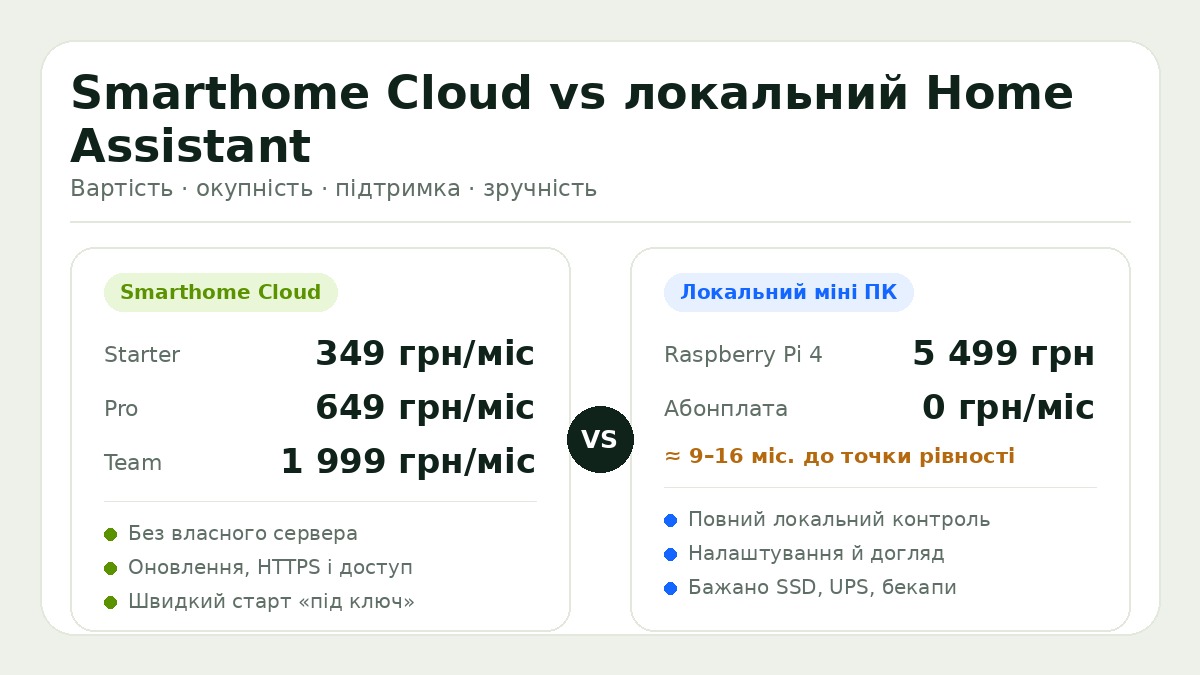
For comparison, we use Smarthome Cloud plans: Starter — 349 UAH/month, Pro — 649 UAH/month, Team — 1,999 UAH/month. The local option is a Raspberry Pi 4 Model B, 2GB mini PC for 5,499 UAH.
Direct Cost Comparison
| Option | Upfront cost | Monthly cost | 1 year | 2 years |
|---|---|---|---|---|
| Smarthome Cloud Starter | 0 UAH | 349 UAH | 4,188 UAH | 8,376 UAH |
| Smarthome Cloud Pro | 0 UAH | 649 UAH | 7,788 UAH | 15,576 UAH |
| Smarthome Cloud Team | 0 UAH | 1,999 UAH | 23,988 UAH | 47,976 UAH |
| Raspberry Pi 4 2GB | 5,499 UAH | 0 UAH* | 5,499 UAH | 5,499 UAH |
\* Excluding electricity, microSD/SSD, power supply, case, UPS, domain, HTTPS, backups, and maintenance time.
When Raspberry Pi Reaches Payback
If we compare only the Raspberry Pi price against subscription fees, the break-even point is:
| Comparison | When local becomes cheaper |
|---|---|
| Raspberry Pi 4 vs Starter 349 UAH/month | about 16 months |
| Raspberry Pi 4 vs Pro 649 UAH/month | about 9 months |
| Raspberry Pi 4 vs Team 1,999 UAH/month | about 3 months |
This is pure math. In practice, Raspberry Pi usually needs extra costs: a good power supply, SSD instead of microSD for reliability, case, cooling, UPS, and time to configure secure remote access.
Convenience and Support
Smarthome Cloud wins when fast start matters: no server purchase, no storage preparation, no network, HTTPS, backup, or monitoring setup. It is especially convenient for apartments, rental properties, small offices, and users who want Home Assistant without Linux administration.
Local Home Assistant is strong when full control matters: everything runs in your network, there is less internet dependency, and you choose hardware, storage, and update policy. But control brings responsibility: if the microSD fails, remote access breaks, or an update breaks an integration, it is your task to fix it.
Reliability
Raspberry Pi can be stable, but for Home Assistant it is better not to rely on microSD as primary storage. History database, logs, and updates wear cards quickly. For a real site, SSD, backup power, and regular backups should be planned from day one.
In the Cloud model, these operational tasks move away from the site. It does not replace good sensor, Zigbee/Z-Wave, or automation design, but it reduces server maintenance.
Which Option Fits
Starter is good for a first launch: apartment, small home, basic integrations, a few automations, remote access without a separate server.
Pro fits an active smart home: more devices, energy monitoring, automations, backups, and more predictable resources.
Team makes sense for multiple sites, teams, integrators, or commercial use where scaling, access control, and centralized support matter.
Local Raspberry Pi is best for technical users or those who specifically want local infrastructure and are ready to maintain it.
Conclusion
Looking only at money, Raspberry Pi becomes cheaper after 9–16 months compared with Starter/Pro. But when setup time, backups, remote access, updates, and support are included, Smarthome Cloud is often better for users who need the result, not server administration.
The simple rule: choose local Home Assistant for DIY and full control; choose Smarthome Cloud for fast start, convenience, and predictable support.